
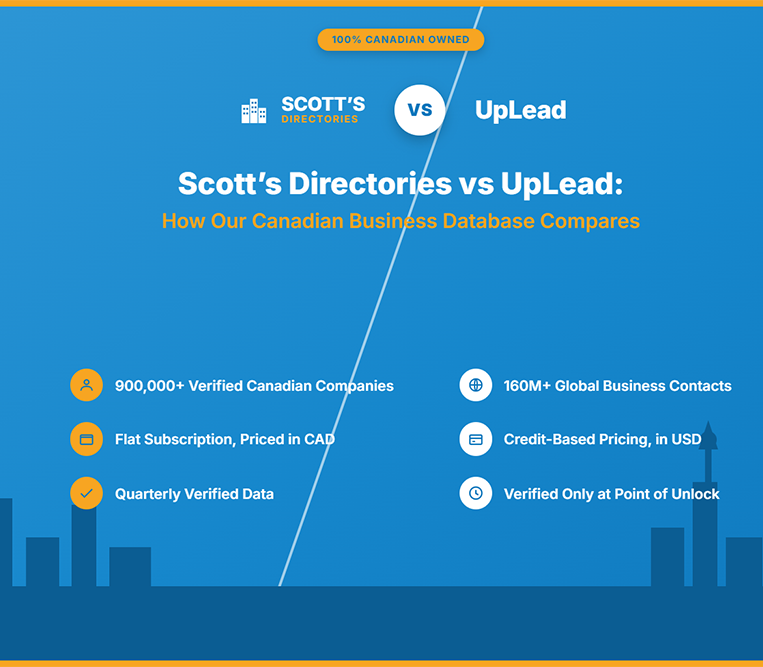
When choosing a B2B contact database for a Canadian sales team, you’ll usually weigh a handful of well-known platforms, and UpLead shows up in that search more often than most. Maybe you typed “Scott’s vs UpLead” straight into Google. Maybe you just went looking for an UpLead alternative in Canada and ended up here. Either way, this page lays out how each platform describes its own data, pricing, and verification process, so you can see which one actually fits a team focused on the Canadian market.
We built it to be a reliable reference you can actually use. Every claim about UpLead comes from UpLead’s own published materials or a credible independent review, and everything here about Scott’s Directories reflects our current data and pricing. That way, you’re working from verified details, not guesswork.
Here’s the short version of why these two platforms are compared so often: Scott’s Directories and UpLead take different approaches to building a contact database. We built ours entirely around the Canadian market, with a flat-rate subscription. UpLead built a global platform on a credit-based model. That single difference shapes everything you’ll read below, from pricing to how current the data stays over time.
Why Canadian Teams Choose a Database Built Only for Canada
Strip away the marketing and a Scott’s Directories vs UpLead comparison comes down to two different starting points. UpLead starts from a huge, global pool of contacts and checks a record the moment someone spends a credit to see it. We start with a smaller, Canada-only pool, and we check everything on a fixed schedule, whether or not anyone has looked at a given record that quarter.
Built for Canada, Not Adapted to It
UpLead’s website puts its database at more than 160 million verified business contacts and 16 million company profiles across over 200 countries. That’s the platform’s whole point. A rep in Toronto and a rep in Singapore are pulling from the exact same global pool. Our database doesn’t work that way. It only contains Canadian companies and executive contacts, verified quarterly according to our own published figures. If your team sells exclusively in Canada, a Canadian alternative to UpLead built this way tends to return more relevant results, simply because nothing in the dataset lives outside the market you’re actually targeting. This is usually the first tradeoff teams run into when they start weighing an UpLead replacement in Canada, long before they even get to the pricing page. It also shapes how search feels day to day. A global database has to decide how deeply it verifies records in any one country, while a Canada-specific database can put that same effort entirely into one market. For a Scott’s vs UpLead comparison focused on everyday search quality in Canada, where the verification work actually goes tends to matter more than the headline contact count either company likes to lead with.
A Flat Subscription You Can Actually Plan Around
UpLead runs on credits. Unlocking a contact, meaning the email and any available phone number, costs one credit from a monthly allowance tied to your plan. We don’t do that. We charge a flat subscription in Canadian dollars, with nothing metered per contact. So an UpLead vs Scott’s Directories pricing comparison really comes down to this: a usage-sensitive plan priced in US dollars, versus a flat Canadian dollar subscription. Which one ends up cheaper depends entirely on how many contacts your team actually unlocks in a given month.
What We Offer vs What UpLead Offers
Numbers only tell part of the story. What matters more is what each database is actually built to do for the person using it.
What Scott’s Directories Offers
Our database includes more than 900,000 Canadian companies, 6.1 million executive contacts, 3.6 million verified email addresses, 5.6 million company phone numbers, 1.1 million direct phone numbers, and 5.9 million LinkedIn profile links, all compiled and verified quarterly. You can search our Canadian business database using more than 40 data fields, including industry, company size, revenue range, and geography, and export every record by province rather than treating the country as one undivided unit. If you need contact records on their own, separate from a full company profile, we also keep a dedicated business contacts database for exactly that. That combination- Canadian-only coverage, quarterly verification, and province-level detail, is built around one job: helping a Canadian sales team reach the right decision-makers without sifting through records that were never relevant to begin with.
What UpLead Offers
UpLead’s site claims its database includes more than 160 million verified business contacts and 16 million company profiles across more than 200 countries. The company backs that with a 95 percent accuracy guarantee and refunds credits automatically when an unlocked contact turns out to be invalid. There’s also an enrichment API for teams matching existing records programmatically. That scale suits a team prospecting well beyond Canada, though it isn’t purpose-built around any single market, Canada included, so it doesn’t offer the depth of a Canada-only database.
Features Each Platform Offers
Scott’s Directories Features
Our filtering runs on more than 40 data fields, organized around Canadian industry classification using NAICS database, the same categories Statistics Canada and other Canadian institutions use. Every list exports in a CRM-ready format, so a subscriber can upload it straight into whatever CRM or outreach tool their team already uses, with no native integration required. Saved searches let you rerun the same filter set whenever a campaign comes back around, which makes it easy to build business prospect directory quarter after quarter without starting from scratch. None of this is metered per contact, so a team can work with every record a search returns rather than rationing a smaller allowance.
UpLead’s Features
UpLead’s site describes more than 50 search filters, covering job title, technology used, company size, and seniority, but it doesn’t mention a Canada-specific classification layer. It integrates natively with Salesforce, HubSpot, and Pipedrive, and offers API and Zapier access, plus a Chrome extension to find contacts while browsing LinkedIn or a company site. These are solid tools for a broad, international search, though they weren’t built around Canadian categories specifically.
Pricing in Practice
Because the two models convert currency differently and are structured differently, it’s worth looking at both the sticker price and what that price actually buys.
| Factor | UpLead | Scott’s Directories |
|---|---|---|
| Pricing model | Tiered, credit-based, one credit per contact unlock | Flat subscription, priced in Canadian dollars |
| Free option | 7-day trial with 5 credits | Free trial, no credit card required |
| Currency | US dollars | Canadian dollars |
| Data focus | Global contact database | Canadian business database |
| Stated verification | Real time, at the point of unlock | Quarterly, according to our website |
What We Charge
We price in Canadian dollars, with no credit system sitting on top. The free trial doesn’t need a credit card, and setup happens the same business day. Saved searches, dynamic lists, and CRM upload are included in the base subscription rather than sold as extras. Since the price doesn’t change based on how many contacts a team exports in a month, budgeting for a full quarter is far more predictable than estimating credit usage ahead of time. Start a free trial to see our current plans firsthand.
What UpLead Charges
UpLead publishes three plans. Essentials costs 74 US dollars per month billed annually, or 99 US dollars monthly, and includes 170 credits. Plus costs 149 US dollars per month billed annually, or 199 US dollars monthly, and includes 400 credits, plus technographic filters and data enrichment. Professional is a custom annual contract with full API access and a dedicated success manager. Credits don’t roll over, and teams that run out mid-cycle can buy more or upgrade, adding variable cost on top of the base plan during busier months.
Keeping Data Current: Quarterly Verification vs Real-Time Checks
We compile and verify our database quarterly, reviewing and updating company and contact records four times a year across our national and provincial directories, regardless of how often any single record gets viewed. UpLead checks an email the moment someone spends a credit to unlock it, according to its own site, so a record can look accurate the day it’s purchased and then quietly go stale weeks later when a person changes roles, since nothing prompts another check until someone searches for that contact again. A scheduled cycle like ours refreshes the whole dataset on a known rhythm instead, so the accuracy of what you’re looking at doesn’t depend on how recently someone happened to search for that contact.
Switching From UpLead: What Actually Changes
Replacing a contact database sounds like more work than it usually is. Here’s what switching actually involves:
- No account migration to manage. There’s nothing locked into UpLead’s system that you’d need to untangle first.
- Exports drop straight into your existing stack. Every list from Scott’s Directories comes in a CRM ready format, the same way an export from any other platform would.
- You can run both during a transition. Some teams keep UpLead for anything outside Canada while building new campaigns on Scott’s Directories, then drop down to one once the Canadian side is covered.
- The real adjustment is the dataset, not the setup. If your team is mostly or entirely focused on Canada, switching is less about technical work and more about getting used to a database already narrowed to the market you’re actually selling into.
Getting Started and Ongoing Support
Every Scott’s Directories subscription includes a dedicated customer service team, free training, same-day account setup on business days, and a free trial that doesn’t require a credit card. New subscribers usually start with a short onboarding call covering saved searches and export formats, rather than being handed the platform and left to figure it out alone. Our reviews are hosted independently, including a 4.8 out of 5 on G2 and a 4.9 out of 5 on Google, and we’ve supported more than 25,000 businesses. You can read client testimonials directly on our site. UpLead, by comparison, offers a 7-day free trial with 5 credits through self-serve sign-up, with broader support like a dedicated success manager reserved for its custom-priced Professional tier.
Industries We Serve
Who We Serve
Our subscribers are B2B sales teams building prospect pipelines, marketing agencies running campaigns, manufacturers sourcing distributors through our Canadian manufacturers directory, recruiters tracking down decision makers, and companies entering the Canadian market from abroad. That base spans manufacturing, logistics, packaging, industrial equipment, and professional services, reflecting how broad our national and provincial directories actually are.
Who UpLead Serves
UpLead’s site positions itself for startups and small- to mid-sized businesses that want precise, self-serve lead targeting, with third-party reviews describing its typical user as a cost-conscious sales rep running smaller-scale outbound campaigns.
What That Looks Like in Practice
Say a manufacturer wants to grow distribution across Western Canada. Normally, that means pulling a provincial business registry in one tab and a separate industry classification list in another, then manually matching them. With our database, they just filter by NAICS code and province at the same time and get a list of distributors in Alberta or BC that actually fit their product category, done. A recruiter searching for decision makers at mid-sized logistics companies runs into the same problem and gets the same shortcut. One search instead of three sources stitched together by hand. That’s what it comes down to: a database built around Canadian categories from day one saves you that stitching work, instead of making you filter through a much bigger, more generic dataset until Canada shows up.
Where a Canada-Built Database Makes the Difference
We built Scott’s Directories for teams focused on the Canadian market, with quarterly verified data, pricing in Canadian dollars, and classifications aligned with NAICS and SIC standards. If predictable subscription pricing and data built only for Canada matter more to you than access to a much larger global pool, it’s worth comparing our database directly against UpLead’s platform using what’s laid out on this page.
Some organizations use both. A team running high-volume, list-based prospecting inside Canada tends to find a flat subscription easier to budget than a credit-based model, while a team doing lighter, ad hoc lookups across a wider set of markets might lean on UpLead’s browser extension for those specific searches. Which setup makes sense really depends on your budget, team size, and how much of your prospecting happens inside Canada versus outside it.
Ready to see how our Canadian business database fits your own targeting needs? Contact Scott’s Directories to get started.
Frequently Asked Questions
UpLead runs a tiered, credit-based pricing model in US dollars, where unlocking a contact eats into a monthly credit allowance. We run a flat subscription model priced in Canadian dollars, and our free trial doesn't need a credit card to start.
Not according to its own site. UpLead's database spans more than 200 countries, with no stated concentration in Canada. If Canada is your main focus, it's worth confirming directly with UpLead how much of that total actually falls within Canadian borders before assuming it matches a Canada-only database. Ours is built exclusively around Canadian companies and executive contacts.
Yes. Our platform focuses on Canadian companies and executive contacts, verified quarterly, which tends to fit a team focused on Canada more directly than a global database that treats Canada as just one market among many.
Yes. Plenty of organizations use a global tool like UpLead for occasional lookups outside Canada, while leaning on a dedicated Canadian database like ours to build verified, larger scale prospecting lists back home.