
If you sell into the Canadian market, you’ve probably run into the same fork in the road: do you invest in ZoomInfo, the global sales intelligence giant, or Scott’s Directories, the database that’s been mapping Canadian businesses since 1957? It’s one of the most common questions Canadian sales and marketing leaders ask when they’re building out a prospecting stack. It’s easy to see why: both platforms promise the same basic thing (find the right companies, find the right people, and reach them faster), but they go about it in very different ways.
This guide is a deep, practical Scott’s vs ZoomInfo comparison built specifically for Canadian buyers. We’ll walk through database coverage, contact quality, search capabilities, pricing philosophy, and, most importantly, which type of company each platform best fits. Whether you’re searching for a ZoomInfo alternative in Canada, evaluating a ZoomInfo competitor in Canada, or simply trying to understand ZoomInfo vs Scott’s Directories pricing before a renewal conversation, you’ll find the answers here.
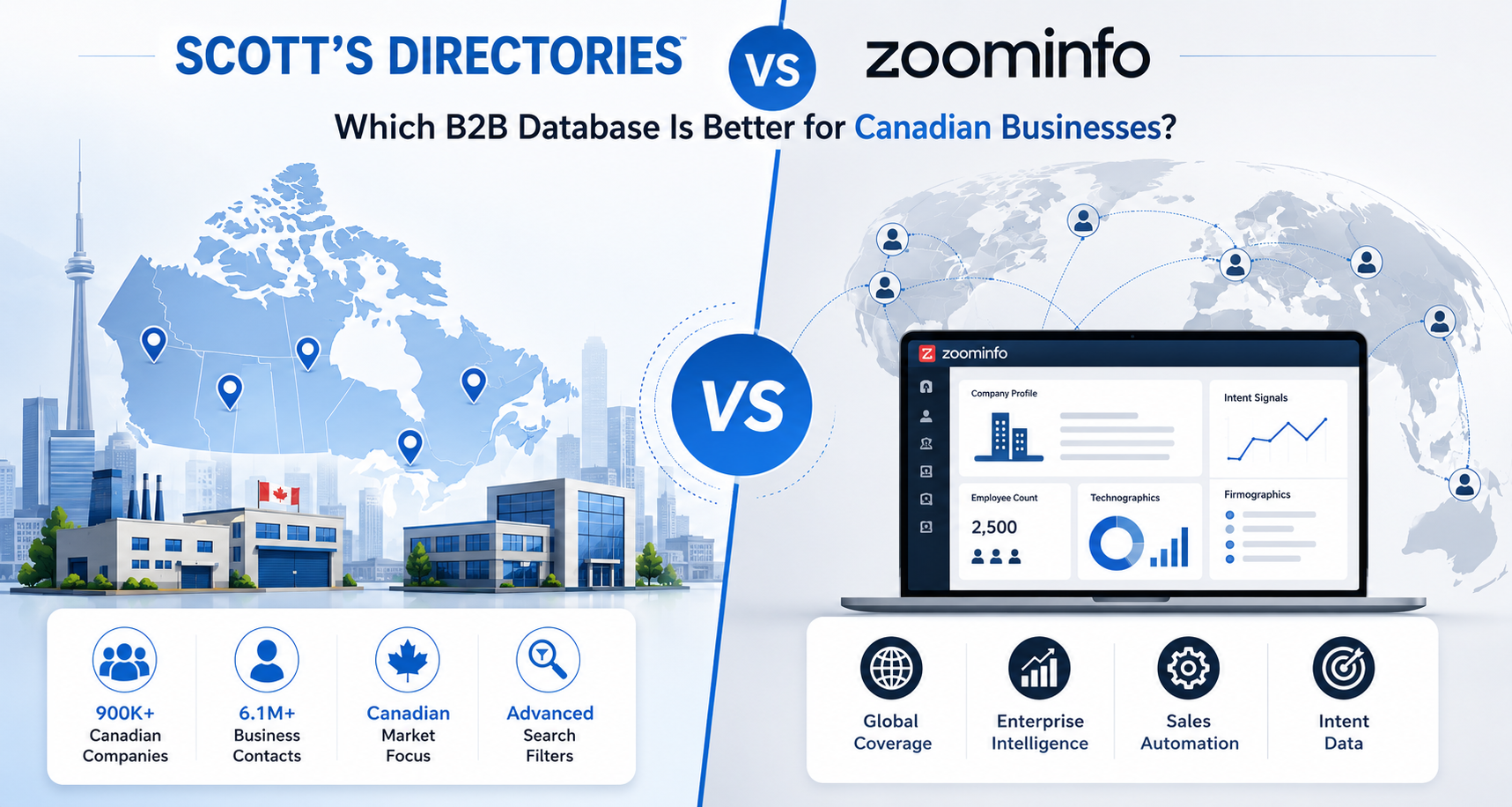
Key Takeaway
Choosing the right B2B database depends on where your customers are and how your sales team generates leads. This comparison explains the differences between Scott’s Directories and ZoomInfo in terms of Canadian business coverage, data quality, prospecting capabilities, pricing, and ideal use cases, helping organizations select the platform that best supports their sales strategy.
Why Canadian Businesses Need Reliable Sales Intelligence
Sales intelligence platforms exist to solve one problem: helping revenue teams find and reach the right prospects without wasting hours on manual research. In theory, any database with enough company and contact records can do this. In practice, the platform you choose has an outsized effect on how efficient and how compliant your outbound efforts actually are.
That’s especially true in Canada. Canadian businesses operate under the Canadian Anti-Spam Legislation (CASL), a stricter regulatory regime than most U.S.-built platforms are designed around. Canadian company data is also a smaller slice of most global databases, which tend to be built with the U.S. market as the primary focus and everything else treated as secondary coverage. That combination of a smaller market, stricter compliance rules, and databases that weren’t necessarily built with Canada in mind is exactly why so many Canadian sales teams end up comparing Scott’s Directories and ZoomInfo before committing to either.
This is also why the comparison isn’t as simple as “which platform has more total records.” A database with hundreds of millions of global contacts isn’t automatically better for a company selling exclusively to Ontario manufacturers or Quebec distributors. Depth and relevance in your actual target market often matter more than raw global scale.
What This Comparison Covers
Over the course of this blog, we’ll break down:
- What to actually look for in a Canadian B2B database
- How Scott’s Directories and ZoomInfo stack up on company and contact coverage
- Search and prospecting capabilities on both platforms
- Data accuracy, verification, and compliance
- Pricing structure and value for Canadian organizations
- Which platform is genuinely best suited for
- Answers to the most common questions people ask when comparing the two
Which Businesses Each Platform Is Designed For
At a high level, Scott’s Directories is built around one country: Canada. It doesn’t try to be a global database; it tries to be the most complete, most accurate database of Canadian businesses available, with a specific focus on manufacturers, industrial suppliers, distributors, and corporate Canada more broadly.
ZoomInfo, by contrast, is a global sales intelligence and go-to-market platform. It covers companies of every size worldwide, layering in intent data, sales engagement tools, conversation intelligence, and a broader software suite on top of its core contact and company database. Canadian data is available in ZoomInfo, but it’s one market among many, not the product’s entire focus.
That distinction, Canada-first versus global-first, is the thread that runs through almost every difference between the two platforms.
See how verified Canadian business data can support your prospecting goals. Book a Free Trial today.
What Should You Look for in a Canadian B2B Database?
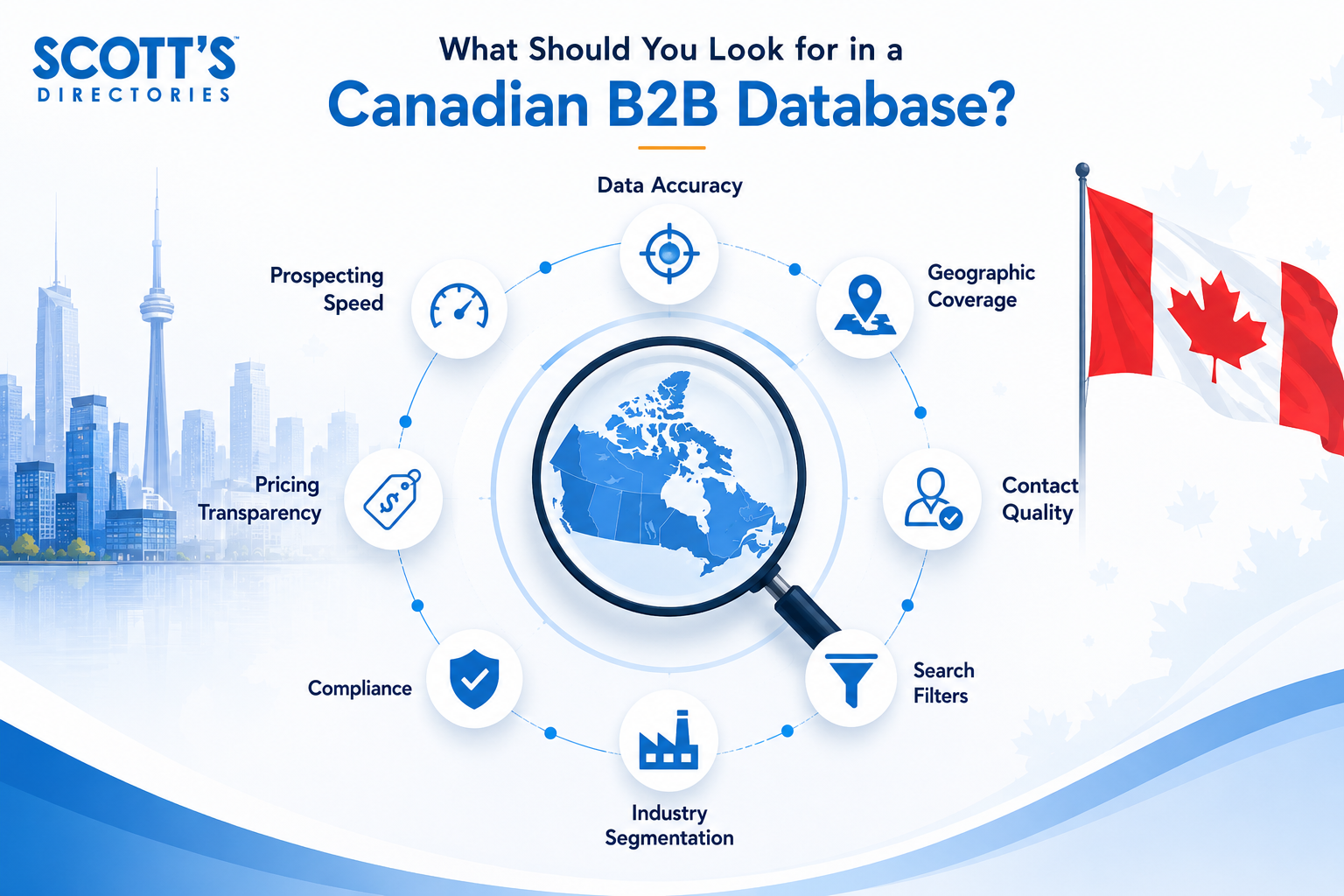
Before comparing the two platforms feature by feature, it helps to define what actually matters when you’re evaluating any database for the Canadian market. Here’s the checklist most sales operations teams should be running through:
Data accuracy. Stale or duplicated records waste rep time and hurt sender’s reputation when emails bounce. Accuracy should be measured, not assumed; ask any vendor how they define and verify it.
Geographic coverage. Does the platform have deep coverage across every Canadian province, or is it concentrated in a handful of major metro areas? A database that’s strong in Toronto and Vancouver but thin in Manitoba or Atlantic Canada won’t serve a truly national sales strategy.
Contact availability. Company records are only half the equation. You need verified contacts, ideally decision-makers attached to those companies, not just a generic “info@” email.
Search capabilities. Advanced filtering by industry code, revenue, employee count, ownership structure, and executive title is what separates a usable prospecting tool from a static list.
Industry segmentation. Manufacturing, construction, transportation, and professional services: each vertical has distinct buying patterns, and a database that cleanly segments by industry classification (SIC/NAICS) makes targeted outreach far easier.
Ease of prospecting. How quickly can a rep go from “I need companies that match X criteria” to an exportable list?
Compliance. In Canada, this means CASL. A platform that doesn’t help you stay within CASL’s boundaries can create real legal exposure.
Pricing transparency. Can you actually understand what you’ll pay, or does every quote require a sales call and a multi-week negotiation?
Keep these eight criteria in mind; they’re the lens we’ll use throughout the rest of this comparison.
Scott’s Directories vs ZoomInfo at a Glance
| Feature | Scott’s Directories | ZoomInfo |
| Geographic focus | Canada-only, purpose-built | Global, with Canada as one market among many |
| Company database | 900,000+ verified Canadian companies | Tens of millions of companies worldwide |
| Contact database | 6.1 million+ verified contacts, largely decision-makers | Large global contact base, with mixed seniority levels |
| Industry classification | Filterable across dozens of categories, including manufacturing, industrial, wholesale, and distribution | Broad industry tagging across global sectors |
| Advanced search filters | 35+ filtering options | Extensive filters plus intent and technographic data |
| Email availability | Compliant approach; email data handled differently than U.S.-style databases | Business emails included as a core feature |
| Compliance approach | Built around Canadian compliance from the ground up | Built primarily around U.S. and global data practices |
| Pricing model | Tiered plans, positioned as more accessible for SMBs and mid-market | Enterprise-oriented, quote-based pricing |
| Best for | Canadian manufacturers, industrial suppliers, distributors, regional and national B2B sales teams | Large enterprises and global or U.S.-heavy sales organizations |
This table is a starting point, not the final word; the sections below unpack each row in more depth.
Build targeted prospect lists with confidence. Book a Free Trial to get started.
Database Coverage: Which Platform Has Better Canadian Business Data?
When people search for a ZoomInfo alternative in Canada, database coverage is usually the first thing they evaluate. It’s a fair place to start, because coverage determines whether you can even find the companies you’re trying to sell to.
Scott’s Directories has built its entire business around a single national market. According to the company, its database includes more than 900,000 verified Canadian companies across every province and spanning categories such as manufacturing, corporate, industrial, wholesale, and distribution. That kind of concentrated, single-market focus means the database can go deeper on regional business types, the kind of mid-sized industrial supplier or regional distributor that a globally-focused database might classify more loosely or cover less completely.
ZoomInfo, on the other hand, is built to scale across many countries simultaneously. Its global database covers tens of millions of companies, with the heaviest concentration of data quality and depth in the U.S. market, where the company built its original data engine. Canadian coverage exists within that global dataset, but it isn’t the platform’s organizing principle, as it is for Scott’s.
Practically, this means:
- If your sales territory is Canada-only or Canada-first, a database purpose-built around Canadian business classifications and regional coverage can surface more relevant regional prospects.
- If your sales territory spans multiple countries, Canada plus the U.S., or Canada plus international markets, a global platform’s breadth becomes more valuable, even if its Canadian depth is comparatively thinner.
Users can also search across millions of verified business contacts tied to those companies, which matters just as much as the company count; a list of 900,000 companies isn’t useful if you can’t find a real person to contact at each one.
Experience smarter Canadian B2B lead generation firsthand. Book a Free Trial today.
Contact Database Comparison
Company records get you in the door; contact records are what let you actually start a conversation. This is where the Scott’s Directories vs ZoomInfo comparison gets more nuanced.
Scott’s reports access to over 6.1 million verified decision-makers across its Canadian database, with a stated focus on ensuring the contacts surfaced are actual decision-makers in purchasing, operations, executive, or management roles, rather than generic staff listings. For sales teams that specifically need to reach economic buyers rather than just any employee at a target company, that kind of decision-maker weighting can reduce wasted outreach.
According to third-party G2 review data, ZoomInfo’s contact database is also well regarded for accuracy and completeness, with reviewers frequently praising its ability to connect them with the right decision-makers and to generate leads efficiently. G2 reviewers also cite its comprehensive filtering options for building targeted customer lists as a particular strength.
However, the same G2 comparison data show a more mixed picture of data quality once you look beyond the top-line satisfaction numbers. Among ZoomInfo’s most-cited drawbacks in G2 reviews are inaccurate and outdated data, two of its top complaint categories, cited in hundreds of reviews. That’s a useful reminder that even market-leading platforms have real limitations, and it’s worth weighing against your own tolerance for data cleanup work.
One important structural difference: Scott’s Directories does not provide contact email addresses as part of its standard offering, a deliberate choice that prohibits harvesting email addresses without consent. ZoomInfo, by contrast, treats business email as a core, standard feature of its contact records. Depending on your outreach strategy, phone- and direct-mail-driven versus email-driven, this difference can matter quite a bit when you’re deciding which platform fits your actual workflow.
Search & Prospecting Capabilities
Sales teams rarely need a simple keyword search; they need to slice a database by geography, industry, revenue band, employee count, ownership structure, and executive title, often all at once, before exporting a workable list.
Scott’s Directories advertises data that’s filterable by roughly 3 dozen criteria, letting users narrow results by province, industry classification, company size, and other business attributes relevant to Canadian B2B sales. That level of filtering is aimed squarely at the kind of territory-based, industry-specific prospecting that Canadian manufacturers, industrial suppliers, and distributors rely on.
ZoomInfo’s filtering goes a layer further in scope, if not necessarily in Canadian specificity. Beyond firmographic filters like industry, revenue, and headcount, the G2 comparison data show ZoomInfo scoring well across features such as lead segmentation and filtering, search functionality, and news and people alerts tools that notify reps when a target account has relevant changes, such as a new executive hire or a funding event. ZoomInfo also offers technographic data (what software and technology a target company uses), buyer intent data, and integrations with CRM and sales engagement tools as part of its broader go-to-market suite, which extends beyond a pure contact database into full sales workflow territory.
The tradeoff is complexity and cost. A platform with intent data, technographics, conversation intelligence, and workflow automation is solving a bigger problem than “find me verified Canadian companies and contacts,” which is exactly the problem Scott’s Directories is built to solve, without the additional layers.
Evaluate the platform with your own target market. Book a Free Trial and explore the database.
Which Platform Is Better for Canadian Lead Generation?
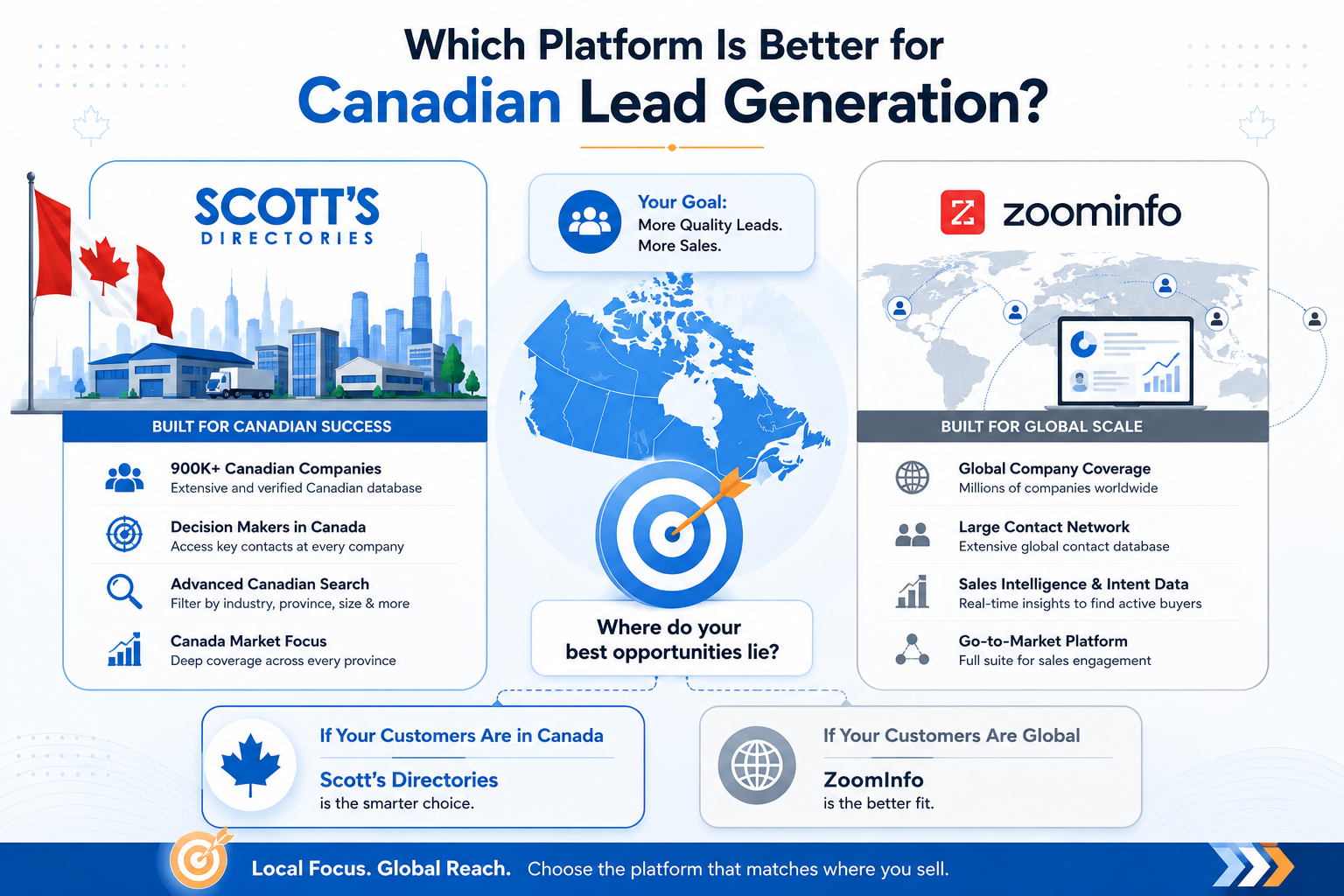
For lead generation, specifically building prospect lists, planning sales territories, and developing a pipeline within Canada, the deciding factor usually comes down to how your team defines “better.”
If better means deepest, most relevant coverage of the Canadian market with straightforward filtering built around Canadian industry categories, Scott’s Directories has a structural advantage: it was built for exactly this use case and has been refined around it for decades.
If better means the widest possible toolset, layering intent signals, technographics, and sales engagement automation on top of contact data, even if some of that toolset is calibrated more heavily around U.S. and global markets, ZoomInfo’s broader feature set is the stronger fit.
Most sales teams evaluating a Scott’s vs ZoomInfo comparison land on one side or the other once they get specific about their actual go-to-market motion, rather than staying in the abstract “which platform is bigger” framing.
Data Accuracy and Verification
Every sales intelligence vendor claims accurate data; the real question is how that accuracy is achieved and maintained.
Scott’s Directories describes its verification approach as built on ongoing, direct outreach to businesses to confirm current information, positioning its update cadence as more frequent than a simple annual refresh. The company also states it can achieve an average data accuracy rate of around 90% through a multi-step verification process. It highlights access to more than 3.6 million verified business email addresses across its broader product suite, which can help reduce bounce rates for organizations that use those email products responsibly under applicable consent rules.
ZoomInfo’s data comes from a combination of automated data mining and human research at a much larger scale, given its global footprint. Independent user reviews on G2 provide a more nuanced picture: reviewers consistently praise ZoomInfo’s data accuracy and real-time updates as core strengths of the platform, but the same review base also flags inaccurate and outdated data as two of ZoomInfo’s most frequently cited weaknesses.
That apparent contradiction isn’t unusual for a database operating at a global scale; accuracy can vary meaningfully by region, industry, and how recently a given record was refreshed, which means your experience may depend heavily on how well ZoomInfo’s coverage lines up with your specific market segment.
The practical takeaway: don’t take either vendor’s accuracy claim at face value. Ask for a trial, run your own target account list through both platforms, and compare match rates and bounce rates directly before committing.
Ease of Finding the Right Decision-Makers
Both platforms are ultimately trying to solve the same core problem: helping you skip past the gatekeepers and reach the person who can actually say yes to a deal, whether that’s a VP of Operations at a manufacturing company, a purchasing manager at a distributor, or a finance lead evaluating a new vendor.
Scott’s Directories positions its contact database around decision-maker identification, specifically, rather than surfacing every employee at a given company. For sales teams whose ideal customer profile is a mid-sized Canadian company where the buying decision rests with a small group of executives or department heads, that kind of centralized, decision-maker-weighted database can shortcut much of the manual LinkedIn research.
ZoomInfo’s scale means it can often surface a wider range of contacts per account, spanning multiple departments and seniority levels, useful for account-based approaches where you want to map an entire buying committee rather than a single point of contact. The tradeoff, per the G2 review data referenced earlier, is that not every contact in that broader set is guaranteed to be current or a genuine decision-maker.
Pricing Comparison: Scott’s Directories vs ZoomInfo
Pricing is consistently one of the top reasons people search for a ZoomInfo replacement in Canada, and it’s also one of the hardest things to compare directly, since neither vendor publishes a simple public price list.
According to G2’s pricing data, ZoomInfo’s entry-level plan requires contacting sales directly, with per-seat pricing not publicly listed, a common structure for enterprise software, but one that can make budgeting difficult for smaller teams and typically involves a sales cycle before you even see a number. ZoomInfo’s broader “GTM Workspace” platform is sold across multiple editions, again gated behind a sales conversation.
Scott’s Directories, similarly, does not publish exact pricing publicly and directs prospective customers to request a quote. Still, the company positions itself as offering multiple tiers designed to be more accessible to small- and mid-sized Canadian businesses without requiring the large annual enterprise commitment typical of ZoomInfo’s contracts.
Rather than comparing raw numbers, it’s more useful to compare value structure:
- Contract flexibility. Scott’s is generally positioned as more accessible for smaller teams and shorter commitments; ZoomInfo’s plans, particularly at the enterprise tier, tend to involve larger annual contracts.
- Feature bundling. ZoomInfo’s pricing reflects a much broader software suite: sales engagement, intent data, and conversation intelligence, so part of what you’re paying for is functionality beyond the core database. If you only need accurate Canadian company and contact data, that bundled complexity may be more than you need.
- Data ownership. This is a meaningful, often-overlooked pricing consideration. Scott’s Directories markets that the data you purchase remains yours to keep and export (e.g., in CSV format) even after your subscription ends, whereas ZoomInfo access is generally tied to an active subscription; once you stop renewing, you typically lose access to previously exported data usage rights under the platform’s terms. If your team wants to build a permanent, owned prospect database rather than rent access to one, that’s worth factoring into any pricing comparison.
- Support model. Scott’s states that dedicated customer success support is included across its plans, while some vendors in this space, including, according to third-party comparisons, ZoomInfo, reserve dedicated support for their highest-tier enterprise plans.
For Canadian organizations weighing ZoomInfo vs Scott’s Directories pricing, the real question isn’t “which number is smaller?” It’s “which pricing structure matches how our team actually wants to buy and own data.”
Find the right companies and decision-makers faster. Book a Free Trial and see the difference.
Who Should Choose Scott’s Directories?
Based on everything above, Scott’s Directories tends to be the stronger fit for:
- Canadian manufacturers who need to identify and reach other manufacturers, suppliers, or industrial buyers within Canada
- Industrial suppliers and distributors whose entire customer base is domestic
- Construction companies targeting regional or provincial markets
- Transportation and logistics companies operating within Canadian trade lanes
- Professional services firms (accounting, legal, consulting) selling primarily to Canadian businesses
- Regional or territory-based sales teams that need granular, province-by-province coverage rather than a broad global reach
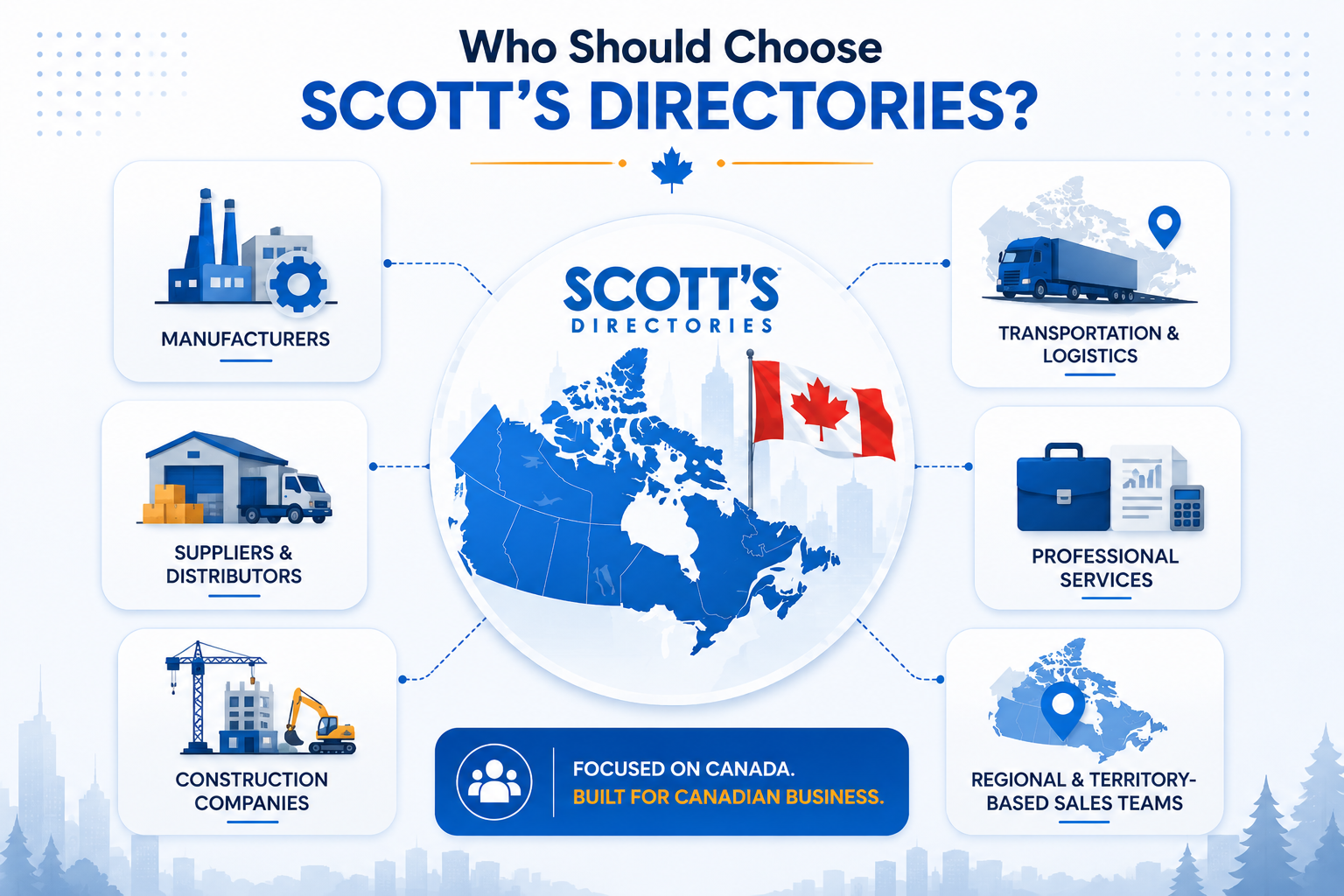
Organizations focused primarily on the Canadian market often derive greater practical value from a platform built specifically for the Canadian business landscape than from a global database in which Canada is a secondary market. Scott’s also emphasizes a long operating history dating back to 1957 and reports that it has been used by tens of thousands of Canadian businesses over that time, which can matter to buyers who value an established, long-standing provider with deep institutional knowledge of the Canadian market.
Who Should Choose ZoomInfo?
ZoomInfo is generally the better fit for:
- Large international enterprises that need company and contact data across dozens of countries, not just Canada
- Global SaaS and technology companies selling into multiple regions simultaneously
- U.S.-heavy sales teams where Canada is one territory among several, and the primary market is the United States
- International outbound sales organizations that need intent data, technographics, and sales engagement tooling bundled into a single platform
- Enterprise revenue teams that already run CRM and marketing automation stacks ZoomInfo integrates with, and want a single vendor covering data, engagement, and analytics
This isn’t a knock against ZoomInfo; it’s simply a different tool built for a different scope of problem. If your sales motion is genuinely global, ZoomInfo’s breadth and feature depth are hard to replicate with a Canada-only provider.
Scott’s Directories vs ZoomInfo: Pros and Cons
| Scott’s Directories | ZoomInfo |
| Pros:
Deep, purpose-built Canadian coverage; decision-maker-focused contacts; compliance-aligned approach; data ownership retained after subscription ends; accessible pricing tiers; dedicated support included across plans |
Pros:
Massive global database; strong search and filtering; intent data and technographics; broad CRM/sales tool integrations; well-established enterprise track record |
| Cons:
Limited relevance outside Canada; smaller total contact volume than a global platform; email data restricted under a compliant approach |
Cons:
Frequently cited data accuracy and freshness issues in user reviews; complex, quote-based enterprise pricing; dedicated support often limited to top-tier plans; data access tied to active subscription |
Final Verdict
There isn’t a single, universal winner in the Scott’s vs ZoomInfo debate, and any comparison that tells you otherwise is oversimplifying a decision that really comes down to where your customers are.
Choose Scott’s Directories if your priority is deep, accurate Canadian business coverage, decision-maker-focused contacts, CASL-aligned data practices, and pricing tailored to small and mid-sized Canadian organizations. It’s a particularly strong fit for manufacturers, industrial suppliers, distributors, and regional or national B2B sales teams whose customer base is entirely or almost entirely Canadian.
Choose ZoomInfo if your sales efforts are primarily global or U.S.-focused, you need intent data and technographics alongside contact information, or you’re already invested in a broader sales engagement and go-to-market technology stack that ZoomInfo integrates with.
For many Canadian sales and marketing teams, the most efficient path forward is actually to test both. Request a free trial of Scott’s Directories and run it against your Canadian target account list, then compare the match rate, contact quality, and workflow fit against your current ZoomInfo usage (or a ZoomInfo trial, if you haven’t used it yet). Data quality claims are easy to make in a comparison blog; the only way to know which platform actually earns your prospecting budget is to see how it performs against your own list.
Frequently Asked Questions
What is the best ZoomInfo alternative in Canada?
Scott's Directories is one of the most established Canadian-focused alternatives, given its decades-long history of building a database specifically focused on Canadian companies and contacts, rather than treating Canada as a single region within a global dataset.
Which platform has better Canadian company coverage?
Scott's Directories reports more than 900,000 verified Canadian companies as its core focus. ZoomInfo includes Canadian companies in a much larger global database, but depth in Canada isn't the platform's primary design focus.
Which platform offers more verified contacts?
In absolute global terms, ZoomInfo's contact database is larger, given its worldwide scope. Within the Canadian market specifically, Scott's Directories reports access to over 6.1 million verified decision-makers, all of whom are Canadian businesses.
How does Scott's Directories compare with ZoomInfo pricing?
Neither company publishes full pricing publicly. Scott's is generally positioned to offer more accessible tiers for small- and mid-sized organizations. At the same time, ZoomInfo's pricing tends to reflect its broader enterprise software suite and typically requires a sales conversation regardless of company size.
Which platform is better for manufacturers?
Canadian manufacturers and industrial suppliers are among Scott's Directories' core use cases, with a dedicated industry classification built around manufacturing, industrial, wholesale, and distribution categories.
Which platform is best for Canadian B2B prospecting?
For prospecting focused specifically in Canada, a database built around Canadian business classifications, decision-maker contacts, and provincial coverage, such as Scott's Directories, is generally more efficient than filtering a global database to a single country.
How many Canadian businesses are included in Scott's Directories?
Scott's Directories reports a database of more than 900,000 verified Canadian companies, spanning every province and multiple industry categories.