
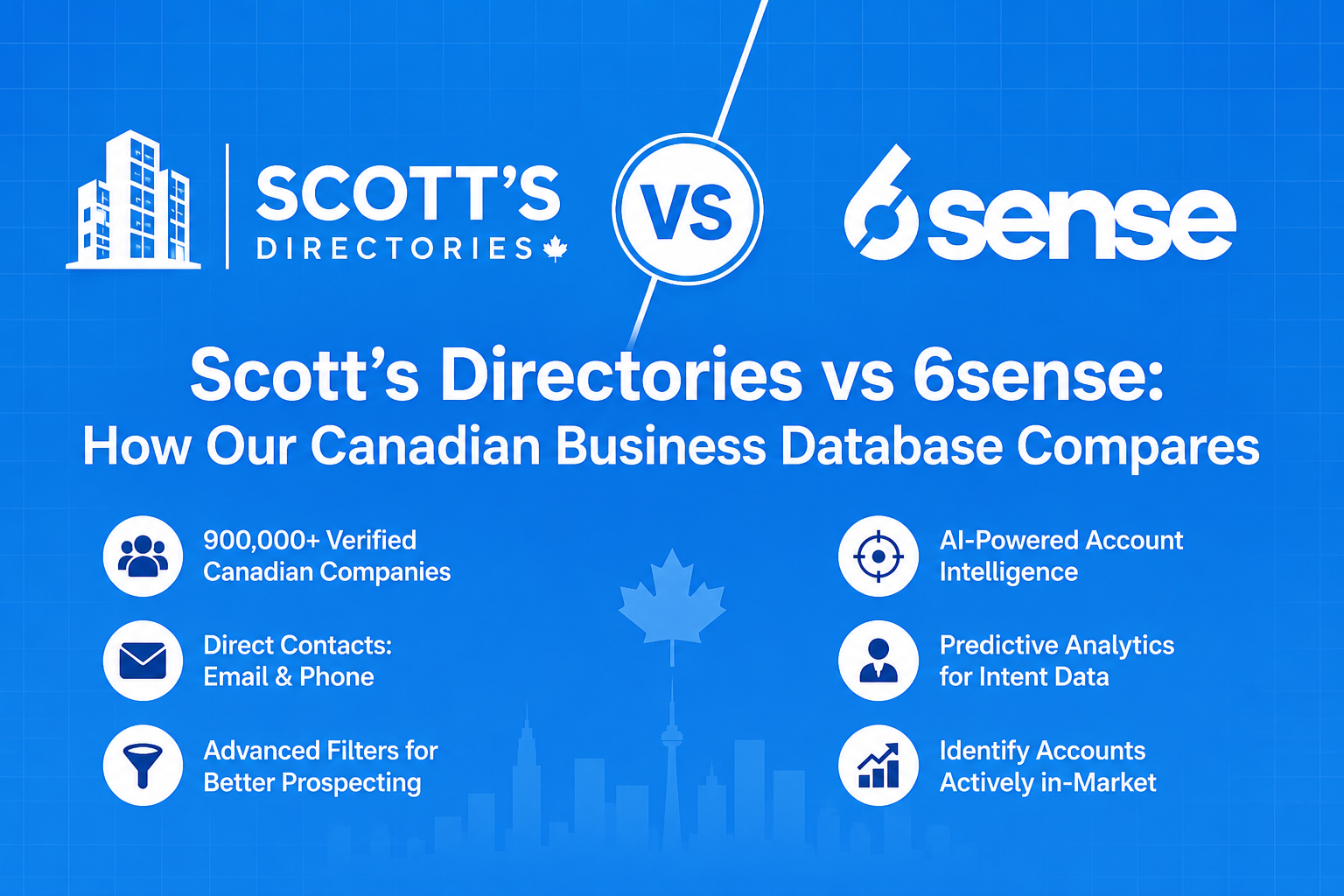
If you are researching account-based marketing or intent data platforms for a Canadian sales or marketing team, you have likely come across 6sense. If you have searched for “Scott’s vs 6sense” or a 6sense alternative in Canada, this page is meant to give you a direct answer. According to its own website, 6sense is an account-based marketing platform that combines intent data, predictive AI, and advertising orchestration. We built Scott’s Directories differently. We focus specifically on verified Canadian company and executive contact data, rather than predictive scoring or advertising orchestration.
This page lays out how we describe our own database, pricing, and features, alongside what 6sense publishes about its platform, so you can compare the two directly. We have tried to keep this page factual rather than promotional. Where we reference 6sense, we have relied on what 6sense publishes about itself, along with figures reported by independent third-party sources that track software pricing, rather than characterizing its platform in our own terms.
Neither platform is presented here as objectively better than the other. Scott’s Directories and 6sense are built to solve different problems for different kinds of teams, and this guide is meant to help you understand that difference clearly enough to decide which one, or which combination, fits your situation.
In Short: Scott’s Directories is a 100% Canadian-owned and operated business database, focused specifically on verified Canadian companies and executive contacts. Our database includes more than 900,000 companies and 6.1 million executive contacts, compiled and verified quarterly, priced as a subscription in Canadian dollars. 6sense is an account-based marketing platform built around intent data and predictive account scoring, with pricing based on a quote rather than published rates. The sections below compare both in more detail.
Why Canadian Teams Look for a 6sense Alternative in Canada
Many of the businesses that reach out to us have already evaluated, or are actively using, an enterprise ABM platform like 6sense. Here is what typically brings them to a Canada-specific alternative.
A Different Kind of Product Entirely
6sense’s own website describes an account-based marketing platform built around intent data, predictive AI, and advertising orchestration, aimed at identifying which accounts in a company’s total addressable market are showing buying signals. The platform describes combining more than a decade of proprietary intent data, referred to on its site as its Signalverse, with a company’s own first-party data and third-party signals such as job changes and funding events.
We built our platform around a different purpose. We provide a verified, searchable database of Canadian companies and executive contacts, without predictive scoring, advertising, or intent modeling. Teams researching a Canadian alternative to 6sense are often looking for straightforward, verified contact data rather than a predictive marketing platform, or are looking to pair the two together for different parts of their go-to-market motion.
Pricing Scale and Structure
6sense does not publish pricing on its website. According to third-party marketplaces that track software contracts, 6sense pricing is typically structured around the size of a company’s total addressable market, the specific modules activated, and the data packages included, with costs generally described as suited to mid-market and enterprise budgets. We price our subscriptions in Canadian dollars, published directly on our products and pricing page, or you can also book a free trial.
A Canada-Specific Focus
Our filtering system, which includes more than 40 data fields, is built around Canadian industry classification using NAICS and SIC codes. 6sense’s own site describes its intent data and Company Graph as covering accounts broadly across markets, without a stated Canada-specific classification structure. Teams whose go-to-market motion is concentrated in Canada often want to understand how a platform’s classification system aligns with Canadian industry categories specifically.
Considering a 6sense alternative for Canadian leads? Book a free trial today!
Understanding Account-Based Marketing and Intent Data
Since 6sense operates in a different product category than ours, it helps to briefly explain what account-based marketing and intent data mean before comparing the two platforms further.
What Account-Based Marketing Involves
Account-based marketing is an approach in which a company identifies a specific list of target accounts, rather than casting a wide net, and coordinates marketing and sales efforts around those accounts. Platforms built for this approach, including 6sense, typically help a team decide which accounts to prioritize and when.
What Intent Data Involves
Intent data refers to signals, often collected from web browsing behavior, content downloads, or third-party research activity, that suggest a company may be actively researching a purchase in a given category. 6sense’s website describes combining this kind of signal with predictive AI to estimate where an account sits in its buying journey.
Where a Business Database Like Ours Fits In
A verified business database like Scott’s Directories does not attempt to predict buying intent. Instead, it provides the underlying company and contact information, verified Canadian companies and their executive contacts, that a team needs regardless of which accounts they have identified as priorities. Some organizations use an intent platform to identify which accounts to target, then use a database like ours to find and verify the contacts within those specific Canadian companies.
Data Privacy and Compliance Considerations
Lead generation and marketing platforms operate under privacy regulations that vary by jurisdiction, and this is worth understanding regardless of which platform you choose.
Canadian Privacy Law and Business Contact Data
Canada’s federal privacy framework, along with provincial legislation such as Quebec’s Law 25, governs how business contact data can be collected, stored, and used for outreach. As a Canadian-owned and operated company, we operate directly under these frameworks. Our database is compiled and verified quarterly as part of our ongoing data management process, though this verification cycle should be understood as part of how we maintain our data rather than as a compliance certification.
Reviewing a Global Provider’s Canadian Compliance Approach
A platform serving enterprise customers internationally, such as 6sense, needs to account for privacy requirements across the jurisdictions where its customers operate, including Canada, particularly given its reliance on third-party intent signals and web tracking data. Reviewing how any provider, us included, describes its approach to Canadian privacy compliance and data sourcing is a reasonable step before signing a contract.
Because we operate exclusively within Canada, our data practices are built around Canadian requirements from the outset, rather than adapted from a broader international framework. This is simply a function of our operating scope, not a claim about relative compliance strength.
Questions Worth Asking Any Provider
Before committing to a platform, ask how contact and intent data is sourced and verified, how opt-outs and data correction requests are handled, and how the provider describes its compliance with Canadian privacy legislation.
What We Offer vs What 6sense Offers
Before comparing pricing or features, it helps to look at what each platform actually is, since the two serve fairly different purposes.
6sense: An Account-Based Marketing and Intent Platform
According to its website, 6sense combines proprietary intent data, described as its “Signalverse,” with first-party data from a company’s CRM, marketing automation platform, and website, along with third-party signals such as job changes and funding events. The platform uses predictive AI to score accounts by buying stage, from awareness through purchase, and includes modules for advertising, sales intelligence, and conversational email. 6sense positions itself as an enterprise ABM platform, according to its own site, and describes identity resolution at the buying group level through what it calls its Company Graph, built from more than a decade of accumulated account data.
Scott’s Directories: A Canadian Business Database
We provide a searchable Canadian business database with verified company profiles and executive contacts. Our database includes more than 900,000 Canadian companies, 6.1 million executive contacts, 3.6 million verified email addresses, 5.6 million company phone numbers, 1.1 million direct phone numbers, and 5.9 million LinkedIn profile links. We compile and verify this data quarterly, export it in a CRM-ready format, and make it searchable using more than 40 data filters, including industry, company size, revenue range, and geography.
We also offer province-specific directories, including listings for Ontario, Quebec, Alberta, and British Columbia, along with sector-specific databases covering healthcare, education, dental, and pharmacy professionals. Each directory product is listed separately on our Canadian business database page, so you can choose a national dataset or a narrower regional or sector-specific one depending on your prospecting focus.
Not sure which approach fits your marketing process? Review our lead generation database page for a full list of products.
Comparing Data Coverage for Canadian Leads
Data coverage is usually a central factor for teams comparing us to 6sense, especially those selling primarily within Canada.
How 6sense Describes Its Data
6sense’s website describes its Company Graph as a structural map of business accounts built over more than a decade, combined with intent signals drawn from proprietary tracking, first-party integrations, and third-party data sources. The platform states that its data is strongest at the account level, covering intent topics and technographic details, and is used primarily to identify which accounts show buying signals rather than to serve as a standalone contact directory.
How We Describe Our Database
Our database covers Canadian companies specifically, with executive contacts, phone numbers, and email addresses verified and updated on an ongoing basis. We compile and verify records quarterly, and profiles include NAICS and SIC industry codes, company size, and geographic segmentation down to the provincial level. Our filtering system also supports segmentation by job title and role, company type and industry, and specific geographic locations, with the ability to export custom business lists by province, including Ontario, Alberta, British Columbia, and Quebec, among others.
Building a list that depends on verified Canadian contact data? A side-by-side Scott’s vs 6sense comparison of each platform’s published scope, like the one on this page, is one way to make that assessment before choosing a platform.
Our Pricing vs 6sense’s Pricing
Pricing structure is one of the clearest differences between the two platforms.
Here is a summary of how each platform’s pricing is structured, based on what each company publishes or has been reported through third-party sources:
| Factor | 6sense | Scott’s Directories |
|---|---|---|
| Pricing model | Quote-based, scaled to total addressable market size and modules activated | Subscription, priced in Canadian dollars |
| Published pricing | Not published; requires a sales conversation | Published on our pricing page |
| Free option | A limited free plan is referenced in third-party reviews | Free trial, no credit card required |
| Target customer size | Generally described as mid-market and enterprise | Any size, no minimum |
| Currency | Typically quoted in US dollars | Canadian dollars |
How 6sense’s Pricing is Structured
6sense does not publish pricing on its own website. Third-party sources that track software purchasing report that 6sense pricing is generally structured around the number of accounts monitored, the specific modules activated, such as advertising or sales intelligence, and the data packages included, with contracts typically negotiated directly with 6sense’s sales team. These third-party sources generally describe 6sense as priced for mid-market and enterprise budgets rather than smaller teams, though exact costs depend on your specific requirements and should be confirmed directly with 6sense.
Because 6sense does not publish rates, comparing its cost to a subscription-based provider like ours generally requires requesting a quote first, rather than comparing published price lists side by side.
How We Price Our Subscriptions
We use a subscription model priced in Canadian dollars, outlined on our products and pricing page. We offer a free trial that does not require a credit card and same-day account setup on business days. Saved searches, dynamic lists, and CRM upload capability are included as part of the base subscription rather than sold as separate add-ons. Our subscriptions run on a 12-month basis, with data updates included throughout the year and no-charge technical support included year-round.
Trying to budget for lead generation without a lengthy sales process? Start a free trial to see our current plans firsthand.
Our Features vs 6sense’s Features
Beyond data and pricing, the two platforms support very different core functionality.
6sense’s Stated Predictive and Orchestration Features
According to its website, 6sense includes predictive account scoring by buying stage, intent topic tracking, identity resolution at the buying group level, advertising orchestration aimed at in-market accounts, and a sales intelligence module. The platform is designed to help a marketing and sales team prioritize which accounts to engage and when, based on predicted buying activity, rather than to serve as a general-purpose contact database.
Our Filtering and Segmentation Features
We built our platform around precise segmentation within the Canadian market. Our filtering supports searches by industry, company size, revenue range, geography, and executive role, letting you build a targeted Canadian list before it ever leaves our platform. We do not include predictive scoring, intent data, or advertising orchestration. Instead, our data is designed to integrate directly into whatever CRM, marketing automation, or outreach tool you already use.
Our typical workflow looks like this: search using advanced filters, refine results using our data fields, review verified executive contact details, export your customized company list, and launch your outreach or marketing campaign using the tool of your choice. This differs meaningfully from 6sense’s published workflow, which centers on identifying and scoring accounts based on predicted buying behavior, then orchestrating advertising and outreach around that score.
Curious whether your team needs predictive account scoring or a dedicated Canadian contact database? Compare our published features against what 6sense describes before deciding.
Support and Onboarding
Each platform describes a different path for getting started.
6sense’s Enterprise Onboarding Approach
Third-party reviews describe 6sense’s onboarding as involving implementation, strategic support, and training, typically quoted and delivered as part of a broader enterprise contract. This reflects the platform’s positioning toward larger marketing and sales organizations with dedicated operations resources.
Our Support Model
We provide a dedicated customer service team and free training with every subscription. Same-day account setup is available on business days, and our free trial does not require a credit card. Our reviews are hosted independently, including a 4.8 out of 5 rating on G2 and a 4.9 out of 5 rating on Google, alongside more than 25,000 businesses that have used our services. You can also read client testimonials and case studies directly on our site.
Want a walkthrough of how our Canadian business database fits into your existing process? Request a free trial to see it firsthand.
How We Keep Our Data Current
Data accuracy tends to decline over time as companies relocate, executives change roles, and contact details go out of date. Here is how we manage that process.
Our Quarterly Verification Cycle
We compile and verify our database quarterly, meaning company and contact records are reviewed and updated four times a year rather than left static between larger updates. This cycle applies across our national directory as well as our provincial and sector-specific databases. Our verification process reviews core details such as company name, address, executive contacts, phone numbers, and email addresses, and updates or flags records that no longer reflect a company’s current status as part of that cycle.
Why This Matters Compared to Intent-Based Signals
6sense’s model is built around real-time and ongoing intent signals rather than a periodically verified contact database, according to its website. The two approaches serve different purposes. Intent data is designed to flag which accounts may be actively researching a purchase, while our quarterly verification is designed to keep core company and contact details, such as names, titles, phone numbers, and emails, accurate and current for direct outreach.
Industries We Serve
Both platforms describe the types of organizations that use them.
Who Uses Scott’s Directories
Our user base includes B2B sales teams building prospect pipelines, marketing agencies executing campaigns, manufacturers sourcing distributors, recruiters identifying decision makers, export companies entering the Canadian market, and investors or analysts conducting industry research. We also maintain dedicated directories for the manufacturing, industrial, wholesale, distribution, healthcare, dental, pharmacy, and education sectors.
Who 6sense Lists as Its Audience
6sense’s website describes its platform as built for mid-market and enterprise marketing and sales teams running account-based marketing programs, typically organizations with dedicated marketing operations or revenue operations resources to manage the platform, according to third-party reviews of its typical customer base.
Not sure which pattern applies to your business? Compare your target account list and team structure against what each platform is built to support.
Choosing the Right Fit
Rather than telling you which platform to choose, this section summarizes how each company describes its own intended use.
How 6sense Describes Its Fit
6sense positions itself as an enterprise ABM and intent platform for organizations running account-based marketing programs at scale, with a stated focus on identifying in-market accounts and orchestrating advertising and outreach around predicted buying behavior.
How We Describe Our Fit
We position Scott’s Directories for teams focused on the Canadian market, built around quarterly verified data, Canadian dollar pricing, and industry classification aligned with NAICS and SIC standards. If your primary need is verified Canadian contact data rather than predictive account scoring, we would encourage you to compare our database directly against 6sense’s platform using the details on this page.
Some organizations use both types of tools together, running 6sense or a similar platform for account-level intent signals while using a dedicated Canadian database like ours for verified contact-level detail. Whether that combination makes sense depends on your budget, team size, and how your marketing and sales functions are structured today.
Ready to see how our Canadian business database compares for your specific targeting needs? Start your free trial or contact our team to get started.